

Referee requests tend to get written at the worst possible moment: a day or two before the submission deadline, squeezed in between matters.
When firms are working on their directories submissions, the referee list is often the last thing finalised and the first thing rushed. That’s a shame, because it’s one of the few parts of the process that involves your clients directly.
For the client, being a referee means finding time in a busy diary, taking a call from a researcher they’ve never met and talking thoughtfully about your work. How you handle that request says a lot about the relationship.
Who makes a good referee
It’s tempting to reach for the biggest name on the client list. Researchers are listening for detail, though, and that comes from the people who worked with you most closely.
The best referees are:
- Close to the work. They instructed you and read the advice, so they can speak with conviction.
- Recent. Ideally from matters in the submission period, and featured in the submission itself.
- Able to speak about individuals. Especially anyone hoping to be ranked or move up.
- Representative. Between them, they reflect the range of work you want to be known for.
- Likely to respond, and on good terms. A referee who never picks up the phone adds nothing, and a client in the middle of a difficult matter may be best left this year.
- It’s also worth checking that no one else in the firm is asking the same client. Three requests from three teams in the same month is a lot to ask of anyone.
Making the ask
The request should come from the person who knows the client best, ideally in conversation first with an email to follow. BD can do the drafting and logistics, with the relationship holder’s name on it. Ask early, and make it easy to say yes or no. Something as simple as this works well:
‘You were such a big part of [matter] this year. Would you be happy to speak to a researcher from [directory] about it? It’s a short call, and absolutely no problem if the timing doesn’t work.’
Before the researcher calls
A short briefing helps them give a confident, specific answer. Aim to jog their memory, and leave the words to them.
A helpful briefing email covers:
- Which directory will be in touch, and roughly when.
- That the call may come from an unfamiliar number or email address, so it doesn’t get missed (it might even land in their junk mail).
- The matter or matters they might be asked about, with a one-line reminder of each.
- The names of the lawyers they worked with, especially anyone hoping to be ranked (but make sure not to overwhelm them with lists of names).
- The kinds of questions researchers tend to ask, such as what sets the team apart, how responsive they are, and how they compare with other firms the client uses.
And double-check their contact details before the submission goes in.
The step most people skip
Once the submission is in, it’s tempting to move straight on to the next thing. Closing the loop is where a lot of the relationship value sits.
Send a personal thank-you once the research period has passed, then get back in touch when the results are published, whatever the outcome.
It doesn’t need to be long: ‘We’ve just had the [directory] results and the team has moved up. Your feedback played a real part in that, so thank you for making the time.’
It’s also an easy reason to check in and hear what’s coming up for them, which is good BD in its own right.
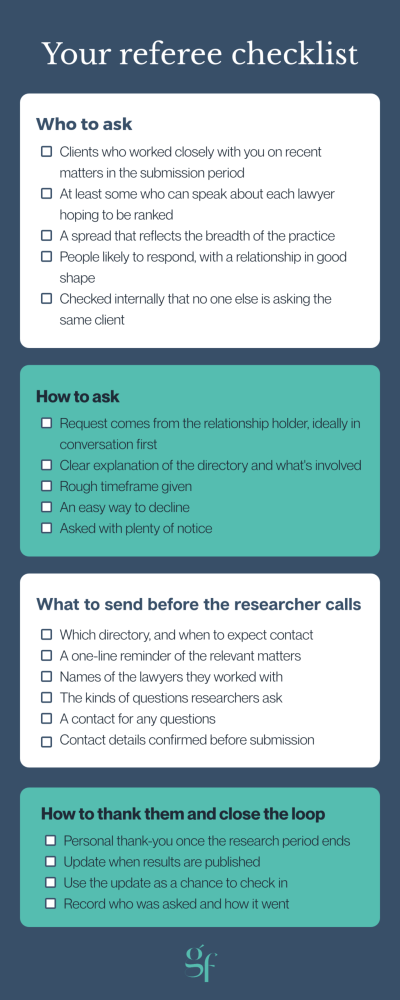
Referee checklist
Below we’ve provided a referee checklist covering four stages: who to ask, how to ask, what to send before the researcher calls, and how to thank referees and close the loop.
Work through it with your BD team and the relationship holders so everyone knows who’s being asked, what they’ll receive, and who will follow up once the rankings are published.
Start with last year’s list
Before your next submission goes in, look back at last year’s referee list. Did each of them hear from you once the results were out? If not, start there.